

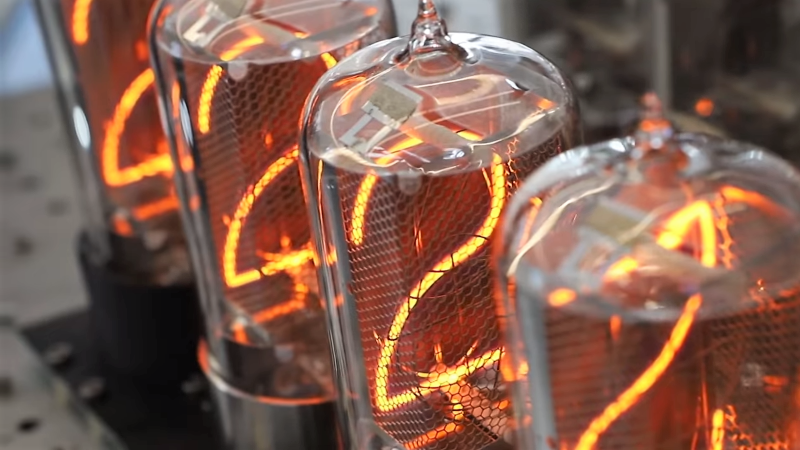
One of our newer writers, [Tyler August], recently wrote a love letter to plasma TV technology. Sitting between the ubiquitous LCD and the vanishing CRT, the plasma TV had its moment in the sun, but never became quite as popular as either of the other display techs, for all sorts of reasons. By all means, go read his article if you’re interested in the details. I’ll freely admit that it had me thinking that I needed a plasma TV.
I don’t, of course. But why do I, and probably a bunch of you out there, like old and/or odd tech? Take [Tyler]’s plasma fetish, for instance, or many people’s love for VFD or nixie tube displays. At Supercon, a number of people had hit up Apex Electronics, a local surplus store, and came away with some sweet old LED character displays. And I’ll admit to having two handfuls of these displays in my to-hack-on drawer that I bought surplus a decade ago because they’re so cute.
Don’t think it quite qualifies as weird, but I still use the CD player that I bought in 1983. It still works well and it’s dead simple, so why not? I think the receipt from Eatons is still around somewhere. It’s a bit too late to return it though.
I think there’s something particularly visceral and real about a lot of old tech. LEDs and circuit boards are miraculous for sure, but it’s all slight tweaks in chemistry of the same thing with different organization. You take a bunch of silicon diodes in 3 different doping levels to make a screen that’s controlled by a fuck ton of silicon diodes in a different doping level with a lead that acts as a transistor, and it may even be powered by a different array of silicon diodes with a different doping to act as a solar panel. It’s miraculous and it’s cool, and it’s massively difficult to comprehend the whole of because of everything it requires to do.
LCD is different, polarized liquid crystals being used to block light is cool and different and once it’s no longer the default its faults moved from annoying to charming.
Plasma screens are cool in part because they were a short lived great tech with plenty of flaws from a time with a lot of hope, especially regarding tech, but also it’s kinda nuts that they worked by ionizing gas. I have one and love it, though it definitely suffers from burn in, which was always a problem they had. It was cool that there was a time when different display techs had different advantages and disadvantages beyond just cost though.
Once you get older than lcds though you get to wild stuff, the era of early and pre microcontroller. A crt doesn’t have pixels, it’s an electromagnetic contraption that requires you to understand physics to understand it, but you can. It isn’t controlled by a computer, but by analog electric waves that used to be beamed out as radio waves. Electromechanical devices feel like machines more than wizardry, and the more complex they are the more awe they demand. Cams and gears working with solenoids and electric motors, where the programming is not words on a screen but physical components that can only be altered by changing the machine itself.
It’s hard to respect devices of silicon as machines. They feel magical enough to act as though they are thinking and mundane enough that they are ever present. While software may have personality, we expect things of silicon to just work or just not work, and their working to be behind so many layers that we only see a bit. The cachunk of a solenoid, the glow of a nixie tube, the heft and hum of a cathode ray tube assure you that this is a machine no different than one of gears. These things each develop their own personalities as many tools do.