• 3 Posts
  • 135 Comments
Joined 3 months ago
cake
Cake day: September 12th, 2025

help-circle


  • I think the first part you wrote is a bit hard to parse but I think this is related:

    I think the problematic part of most genAI use cases is validation at the end. If you’re doing something that has a large amount of exploration but a small amount of validation, like this, then it’s useful.

    A friend was using it to learn the linux command line, that can be framed as having a single command at the end that you copy, paste and validate. That isn’t perfect because the explanation could still be off and it wouldn’t be validated but I think it’s still a better use case than most.

    If you’re asking for the grand unifying theory of gravity then:

    • validation isn’t built into the task (so you’re unlikely to do it with time).
    • validation could be as time intensive as the task (so there is no efficiency gain if you validate).
    • its beyond your ability to validate so if it says nice things about you then a subset of people will decide the tool is amazing.


  • Yeah, for me some of it is that I got more nuanced and forgot the places I used to be black and white / aim for a harsh burn. Not that I’m not still ignorant with plenty of black and what thinking.

    And I think that besides people chasing upvotes, there is also more organising of movements online and by pushing issues into ethical framings that demonise the other side you create anger that keeps a movement going and can be directed but then large groups lose the ability to talk with nuance about that topic


  • Yeah, agreed. It reads as if a bunch of computer scientists did some data analysis without statisticians or biologists.

    Here’s the original paper:

    https://www.nature.com/articles/s41467-025-65974-8

    They’ve taken a number of measured attributes:

    All graph theory metrics were calculated using the Brain Connectivity Toolbox (BCT) in MATLAB 2020b38. Global measures included network density, modularity, global efficiency, characteristic path length, core/periphery structure, small-worldness, k-core, and s-core, while local measures utilized were degree, strength, local efficiency, clustering coefficient, betweenness centrality, and subgraph centrality.

    Smoothed to fit a curve to the data:

    In these models, cubic regression splines were used to smooth across age, and sex, atlas, and dataset were controlled for.

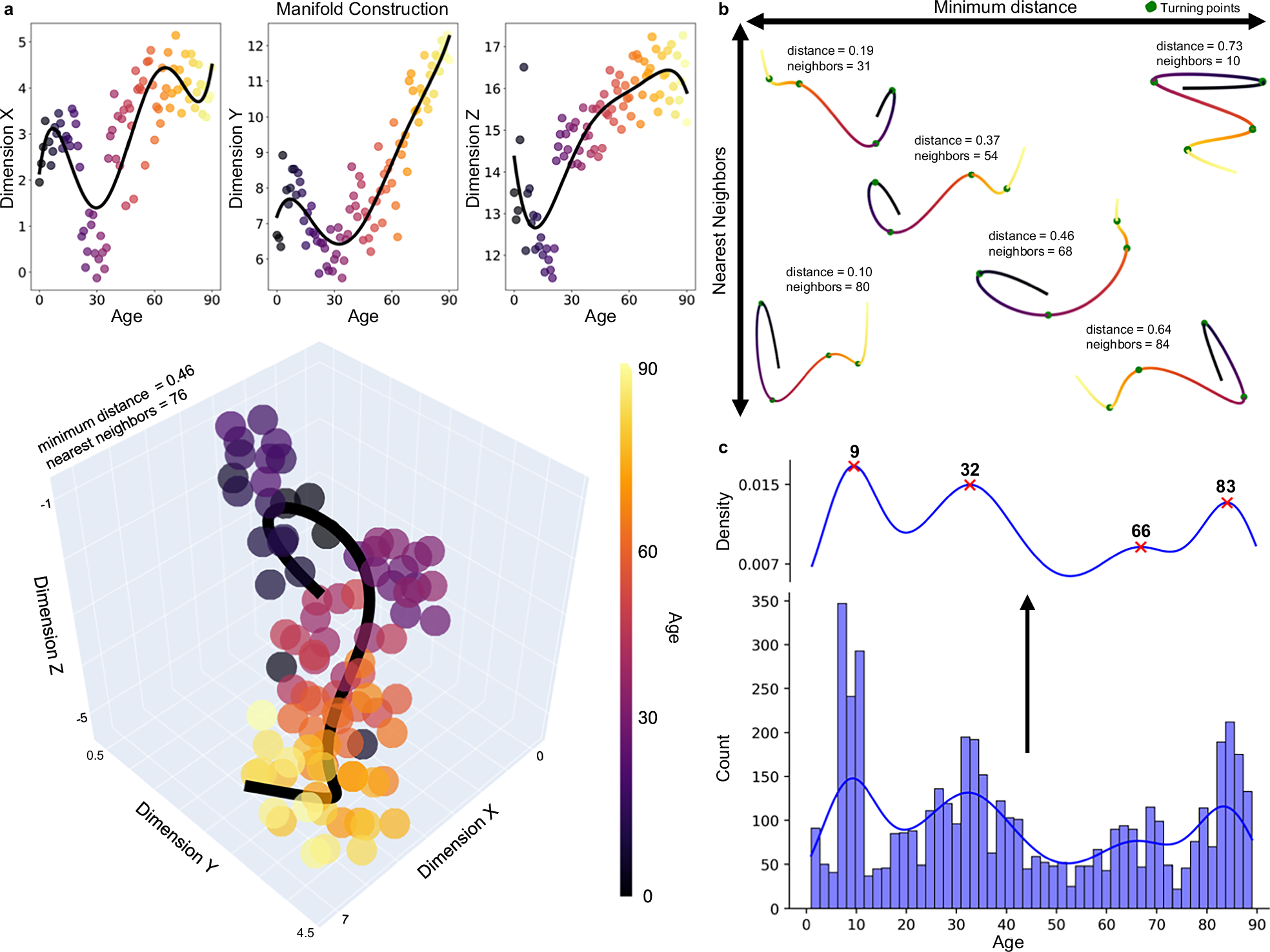
    Reduced the dimensions using Uniform Manifold Approximation and Projection. Basically, if you have this data “height in inches”, “height in cm”, “weight in kg” it would ideally keep “weight” roughly the same but have a single “height” but you couldn’t rely on the units. They condense the input data down to four dimensions keeping age as the independent variable.

    To project topological data into a manifold space, we used the UMAP package in Python version 3.7.335. Before data was put into the UMAP, it was first standardized using Sklearn’s StandardScalar

    Then they created a polynomial fit for each dimension:

    Polynomials were fit using the polyfit() function from the numpy package, which uses least squares error95. Together, these polynomials create the 3D line of best fit through the manifold space. For our main analysis, we fit 5-degree polynomials

    Then they found the turning points and where they were are the ages. Here’s a plot and you can see even after all this cleanup the ages are noisy and it’s really surprising they’ve chosen ages as specific as they have:

    The authors plot for finding turning points

    I have no idea how they went back through to make up the summary for each “epoch” they identified. There’s obviously a lot of information for them to use here but it also seems like there could have been more creative license than ideal.

    It really reads as an early idea that I don’t think should be pushed to the general public until other scientists have scrutinised it more (otherwise you end up with a whole lot of coffee is dangerous, coffee is healthy leading to people not trusting science)


  • Jakkaphong “Anne” Jakrajutatip was charged with fraud then released on bail in 2023. She failed to appear as required in a Bangkok court on Tuesday.

    Jakkaphong and her company, JKN Global Group Public Co. Ltd., were sued for allegedly defrauding Raweewat Maschamadol in selling him the company’s corporate bonds in 2023. Raweewat says the investment caused him to lose 30 million baht ($930,362).

    Financially troubled JKN defaulted on payments to investors beginning in 2023 and began debt rehabilitation procedures with the Central Bankruptcy Court in 2024. The company says it has debts totaling about 3 billion baht ($93 million).

    JKN acquired the rights to the Miss Universe pageant from IMG Worldwide LLC in 2022

    There’s more info in the article but for me the title just needed to say “for fraud” and I would have known I didn’t care enough to read it. I figure some others might be similar